


DynamoDB Global Table FAQs
What are DynamoDB Global Tables Prerequisites?
Before you create a DynamoDB global table, several prerequisites should be met:
- Identical table schemas in each Region: All replica tables in the global table must have the same table name and primary key schema.
- Use supported Global Tables version: You should use Global Tables version 2019.11.21 (Current), which provides improved replication and consistency behavior over legacy versions. This version replaced the legacy 2017.11.29 version.
- Streams enabled (for older setup methods): In some AWS setups, DynamoDB Streams must be enabled so that changes can flow between replicas for replication. Some deployment methods, such as Global Tables, automatically enable Streams that are then used for replication.
- Account or multi-account considerations: If you plan to replicate across AWS accounts, configure the appropriate IAM roles and permissions, as multi-account replication support is now available.
DynamoDB Global Tables require consistent table design, compatible replication settings, and proper permissions across Regions to ensure seamless multi-Region synchronization and availability.
Key Components of DynamoDB Global Tables Architecture
DynamoDB Global Tables architecture includes several core components:
- Replica tables: The building blocks of a global table — each Region has one replica that stores the same dataset.
- Global table configuration: A logical resource that ties all replicas together and manages replication and consistency settings all part of a single replication group.
- Multi-Region endpoints: Applications communicate with DynamoDB using Regional endpoints, but each endpoint participates in the global table.
- Consistency settings: Global tables support multi-Region eventual consistency (MREC) and multi-Region strong consistency (MRSC), which govern how and when replicas converge.
Together, these components allow DynamoDB Global Tables to function as a logically unified, globally distributed database while still operating through independent regional endpoints. Each replica remains fully functional on its own, but replication metadata and synchronization mechanisms ensure data convergence across Regions.
This architecture abstracts much of the operational complexity of multi-Region deployments, enabling applications to scale globally without implementing custom cross-Region replication logic.
ScyllaDB Multi-Datacenter Architecture vs DynamoDB Global Tables
ScyllaDB’s multi-datacenter architecture is based on a peer-to-peer, ring-based topology in which all nodes across all datacenters are equal participants with no single point of coordination. Any node in any datacenter can serve as the coordinator for a given request, and the cluster treats all sites as peers with no concept of a primary region or leader. Operators define independent replication factors per datacenter, giving them direct control over how data is distributed across sites.
DynamoDB Global Tables takes a fundamentally different structural approach: each AWS region maintains a fully independent replica of the table rather than participating in a unified cluster. Regions are loosely coupled, synchronizing through an internal replication stream while remaining capable of operating autonomously, including during inter-region connectivity disruptions. There are no topology decisions for operators to make; the unit of configuration is simply which regions a table should exist in.
The core distinction is that ScyllaDB presents all datacenters as a single logical cluster with a shared, consistent view of the ring, while DynamoDB treats each region as a self-contained system that stays in sync with its peers. This makes ScyllaDB better suited for organizations that need a globally coherent data layer with fine-grained control over placement, while DynamoDB’s regional autonomy model favors those who prioritize fault isolation and operational simplicity over unified cluster management.
How Does DynamoDB Global Table Replication Work?
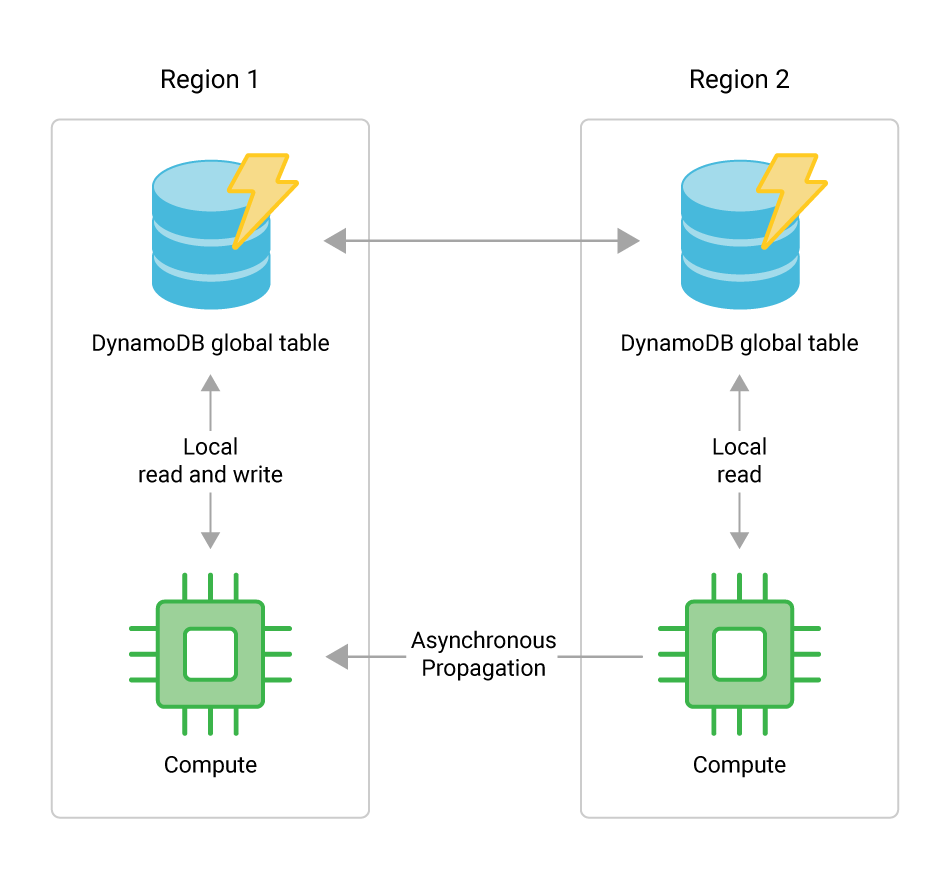
When you write to any replica table in a DynamoDB global table, DynamoDB automatically replicates that write to all other replicas in the global table across Regions. Under the hood:
- Replication occurs through asynchronous propagation (in eventual consistency mode) that typically completes in seconds.
- For strong DynamoDB global tables consistency (if configured), DynamoDB guarantees that a write will succeed when it is applied in the local writing Region, which then DynamoDB ensures the latest data is replicated everywhere.
- If simultaneous writes to the same item occur in different Regions, DynamoDB uses a last writer wins conflict resolution strategy based on timestamps.
This replication mechanism abstracts away the complexity of building and maintaining your own multi-Region synchronization logic.
How ScyllaDB Multi-Datacenter Replication Compares to DynamoDB Global Table Replication
ScyllaDB and DynamoDB handle replication quite differently. ScyllaDB replicates data synchronously or asynchronously, depending on the consistency level chosen at query time. Operators can require acknowledgment from multiple datacenters before confirming a write, enforcing cross-site durability at the cost of latency. This tunable consistency model means that conflict prevention is possible by design, since writes can be forced to succeed only when a quorum across datacenters agrees.
DynamoDB Global Tables on Eventually-Consistent mode always commits writes locally first and propagates them to other regions asynchronously, with replication lag typically under one second under normal conditions. Conflicts arising from simultaneous writes to different regions are resolved automatically via a last-writer-wins timestamp mechanism, entirely transparently to the application. There is no option to require cross-region acknowledgment before a write is confirmed.
DynamoDB Global Tables on Strongly-Consistent mode acknowledges writes only when global replication is achieved, without relying on replication streams.
The practical consequence is that ScyllaDB’s replication model can guarantee that two datacenters never diverge on a given record, at the expense of requiring careful consistency level configuration. Quorum reads and writes can provide strong consistency guarantees if properly configured. DynamoDB’s model guarantees availability and low write latency in every region but accepts that concurrent cross-region writes may result in one silently overwriting another. Teams with strict consistency requirements across geographic sites generally favor ScyllaDB’s approach, while those prioritizing write availability and simplicity lean toward Global Tables.
Difference Between DynamoDB Global Tables vs Local Tables
Understanding the difference between DynamoDB global tables and standard single-Region (local) tables is essential when designing for availability, latency, and disaster recovery. While both use the same underlying DynamoDB service and data model, global tables extend functionality by replicating data across Regions, enabling multi-Region reads and writes. Local tables, by contrast, operate within a single AWS Region and are designed primarily for regional workloads without built-in cross-Region replication. Let’s look at some of the key differences:
| Feature | DynamoDB Global Tables | Local Tables |
|---|---|---|
| Replication | Data is replicated automatically across multiple Regions. | Data resides in one Region only. |
| Multi-Region writes | Supported — you can write to any replica. | Not supported. |
| Consistency options | Multi-Region eventual & strong consistency configurable at table creation time. | Local consistency levels only (single Region). |
| Availability SLA | Higher (99.999%). | Lower (99.99%). |
| Cost model | Replication and multi-Region charges apply . | Standard regional pricing. |
In short, global tables are designed for resiliency and low-latency global access,
whereas local tables are optimized for single-Region performance and simplicity.
DynamoDB Global Tables Limitations Explained
While DynamoDB Global Tables simplify multi-Region deployments, they introduce architectural and operational tradeoffs that teams should understand before adopting them.
Last-writer-wins conflict resolution
When the same item is updated in multiple Regions at nearly the same time, DynamoDB resolves conflicts using a last writer wins strategy based on timestamps. This can lead to lost updates if applications do not carefully design for concurrent writes.
DynamoDB Global Tables Replication latency
Although global table replication typically completes within seconds, it is still asynchronous in most configurations. Applications that require strict cross-Region read-after-write guarantees may need additional logic or stronger consistency settings.
Increased write costs
Every write to a global table is replicated to all configured Regions. This means write traffic effectively multiplies across Regions, increasing overall cost compared to a single-Region deployment.
Cross-Region data transfer charges
Replication between Regions can incur AWS inter-Region data transfer fees, which add to the total cost of operating a global table.
Operational complexity
While AWS manages replication infrastructure, teams must still plan for:
- Multi-Region IAM configuration
- Monitoring replication health
- Capacity planning per Region
- Regional failover strategies
Feature and workload constraints
Certain advanced use cases, such as high write contention on the same partition key across Regions can increase the likelihood of conflicts or performance variability.
DynamoDB global tables provide built-in global availability and replication, but they trade off simplicity for increased cost, consistency considerations, and multi-Region operational planning.
How Much Do DynamoDB Global Tables Cost?
The cost of DynamoDB global tables goes beyond standard single-Region DynamoDB pricing. Because global tables replicate data across multiple AWS Regions, every write operation is propagated to each replica, effectively multiplying certain charges. In addition to standard read and write capacity (or on-demand request units), organizations must account for replicated write charges, cross-Region data transfer fees, storage costs in every Region, and potential index-related expenses. As the number of Regions increases, so does the overall cost footprint. Understanding how these pricing components interact is essential when designing globally distributed applications, especially for write-heavy workloads where replication overhead can significantly impact monthly spend.
DynamoDB global tables introduce additional cost factors compared with single-Region tables:
- Replicated write capacity units (rWCUs): In provisioned mode, writes to a global table consume rWCUs in every Region that contains a replica.
- Replicated write request units (rWRUs): In on-demand mode, replicated writes incur rWRUs that are charged per Region.
- Cross-Region data transfer fees: Because data moves between Regions for replication, AWS data transfer fees may apply.
- Secondary index updates: Writes to global secondary indexes are charged locally as usual, but replicated writes still incur additional costs per Region.
- Bootstrapping new Regions: Adding a new replica can incur one-time restore/replication initialization charges based on table size.
Overall costs scale with the number of Regions and the volume of write traffic – planning for replication overhead is an important part of global table budgeting.
Writing a 3.5KB item to a table replicated across four regions results in four separate charges, each rounded up to the nearest 1KB boundary. Inter-region network transfer adds another layer of cost on top of the per-write charges, and unlike standard write capacity, replicated writes cannot be reserved — leaving teams without a straightforward way to reduce that portion of the bill. Costs scale linearly with the number of replica regions, meaning every region added to a table directly multiplies the effective write cost.
Concurrent writes from multiple regions compound the problem. When two regions write to the same item simultaneously, DynamoDB resolves the conflict using a last-writer-wins strategy — but both writes are charged regardless of which one survives. A write that is ultimately discarded in conflict resolution is still a billable event, meaning teams pay not just for successful writes but for the losing side of every conflict as well.
ScyllaDB Deployment Costs vs DynamoDB Global Tables Pricing
ScyllaDB’s cost model is infrastructure-based: costs are driven primarily by compute and storage resources provisioned. Since ScyllaDB is designed to extract maximum performance from each node through its shard-per-core architecture, operators can often achieve high throughput with a relatively small number of nodes. In multi-datacenter configurations, costs scale with the number of replicas maintained across sites. However, there are no per-request or per-operation charges layered on top of infrastructure costs.
DynamoDB Global Tables pricing is consumption-based. It’s charged:
- Per read and write request unit
- Per GB of storage
- Per replication write unit for each additional region a table is replicated to.
This means that in a multi-region Global Tables setup, every write is billed once in the originating region and again for each replica region. That causes write costs to multiply directly with the number of regions. At low or unpredictable workloads, this model can be cost-efficient. However, at high, sustained write volumes, the per-operation pricing can become significantly more expensive than provisioned infrastructure.
The two pricing philosophies reflect their broader architectural differences. ScyllaDB’s costs are relatively predictable and front-loaded. Organizations pay for capacity whether or not it is fully utilized, but face no surprise charges from traffic spikes. DynamoDB’s costs scale automatically with usage, removing the need to forecast capacity, but can grow substantially in globally replicated configurations with heavy write throughput. Teams with steady, high-volume workloads spanning multiple regions often find infrastructure-based models like ScyllaDB more economical, while those with variable or unpredictable traffic may favor DynamoDB’s on-demand flexibility.