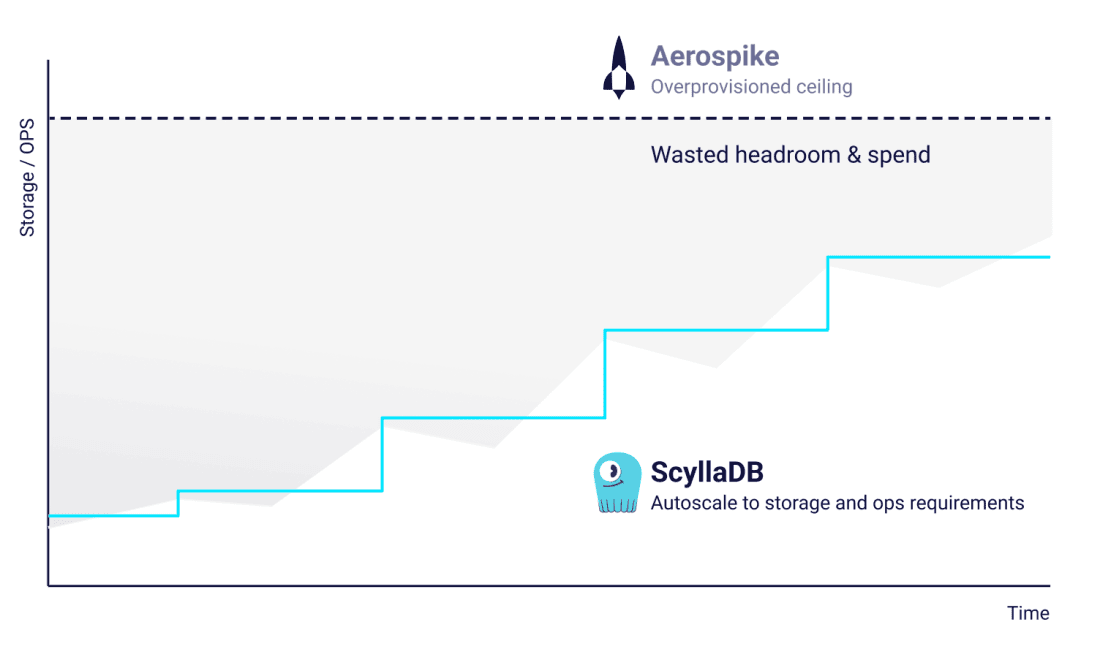
Handle more data, more patterns, on less hardware than Aerospike

See Why ScyllaDB is Different

Top 3 Reasons Teams Switch from Aerospike

Both are Fast…But Fundamentally Different

ScyllaDB and Aerospike are both fast, but their architectures are fundamentally different.

Aerospike is a very good key/value database. Caching keys in RAM while values live on fast NVMe is a novel approach for a simple K/V model. It achieves excellent throughput and superb low latency.

ScyllaDB is a more sophisticated database: wide-column NoSQL, a strict superset of K/V, with millions of independent cells per row, configurable replication, local and global indexes, and true elasticity.

Key-Key-Value, not just Key-Value

ScyllaDB’s clustering keys give every row millions of independently addressable cells. It updates values directly. Aerospike must read the whole object, merge the change, and write it all back.

Indexes don't live in RAM

Aerospike pins 64 bytes per key in memory, always. ScyllaDB indexes from NVMe with comparable latency (RAM is LRU cache, not a prerequisite).

Dense instances, fully used

Limited disk:RAM ratios lock Aerospike out of i8ge / i7ie / i3en-class hardware. ScyllaDB runs them at 90% utilization.

ScyllaDB vs Aerospike Feature Comparison

Is ScyllaDB a good fit for your use case? Learn more about the differences.

ScyllaDB Product Roadmaps

Flexibility
Flexibility Efficiency Scaling Resiliency Lock-In

Flexibility Data Modeling

Aerospike follows a Key-Value approach to data modeling. It organizes data into Namespaces (databases), Sets (tables) and Records (rows). Inside a record, data is stored in Bins (similar to columns in other DBs). It favors single-record lookups (for example, fetching a user profile by its ID) and when more complex data storage is needed it operates similarly to a Document database by aggregating multiple datapoints into a single Record (row).

ScyllaDB’s approach is called Wide-Column, a highly structured tabular model. Data is organized into Keyspaces (databases), Tables and Rows, with Columns to store various data types. Its main Data distribution mode is driven by Partitions. A Partition Key is a Primary Key (or a group thereof) which determines which nodes hold the data. A Clustering Key (or a group…) defines the sorting of rows in the context of a partition.

ScyllaDB’s model supports a significantly richer set of Applications that requires querying relationships or fetching blocks of related data.

Flexibility Range Queries

Aerospike’s fundamental Key-Value design isn’t designed to facilitate fetching a series of related data points. In its design, you either have to rely heavily on Secondary Indexes (which comes with memory/performance overhead) or abuse Collections Data Types (CDTs) like Maps and Lists within a single bin. However, overloading a single record with massive lists can lead to bloated records and create performance bottlenecks.

ScyllaDB’s Clustering Keys natively sort data on disk. As you partition your data by `sensor_id`and cluster it by `timestamp`, you can easily query, for example, “fetch all temperature sensor readings for Sensor A between Tuesday and Friday”. ScyllaDB serves this query via a highly efficient sequential read directly from disk/memory and returns the requested pieces of data. This makes ScyllaDB exceptionally powerful for time-series data, such as event logging, messaging systems and IoT workloads.

Flexibility Schema Structure

Aerospike does not enforce a schema except for its Primary Key. You can write a record with a `user_name` bin as a string, and in the next record, write `user_name` as an integer. This flexibility feels liberating as you get started, but at an Enterprise scale with applications spanning multiple years of development and Production maintenance, this shifts the burden of data validation and schema governance onto the application code. Over time, this creates a multitude of setups where data types are inconsistent and bugs are difficult to track down.

ScyllaDB does enforce a schema under CQL. This guarantees data integrity and predictable data types at the database level. It allows for some dynamicity – you can `ALTER TABLE` to add new columns or collections on the fly without locking the database or experiencing downtime.
Under the DynamoDB-compatible API, ScyllaDB follows the DynamoDB data modeling, which has Primary Key and an optional Sorting Key, with no restrictions on the Item attributes.

Flexibility Advanced Data Views

Often, applications need to query the exact same data from two different perspectives. For example, query a user by `user_id“ or by `email_address`.

Aerospike offers Secondary Indexes, which structurally function as Local Secondary Indexes (LSIs) rather than Global Indexes. Each node maintains a local,  in-memory version of the indexed bin with a reference to the original record. When querying using Secondary Indexes, clients are unaware of which nodes hold the corresponding data, so clients perform a scatter-gather operation which broadcasts the query to all nodes to check for partitions. The partitions are then aggregated on each node and flushed onto the network. This is a highly compute-intensive operation, which drives some users requiring strict latency SLAs to be met to use a dual-write system, writing in parallel to two tables with the corresponding desired Keys, shifting the burden of keeping data between base table and Secondary Index to the application.

ScyllaDB supports three types of data views: both Local and Global Secondary Indexes, and Materialized Views.

  • Local Secondary Indexes work by indexing a non-Primary Key column within the context of a single partition. They are always local to the partition.
  • Global Secondary Indexes work by indexing a column and storing it in a view partitioned by the indexed column. By leveraging the per-partition design, clients can directly query the Global Secondary Index by the content of a desired column. ScyllaDB then issues a read to the row that matches the index row and returns the data to the client. This allows for querying by `email_address` in a highly efficient manner, without involving a major scan.
  • Materialized Views are an even more powerful functionality, where a table has selected columns projected into a View – allowing a local read whenever extremely low latency is needed when querying an Indexed column.

Flexibility Collections and User-Defined Types (UDTs)

Aerospike relies heavily on Collection Data Types (CDTs), especially Lists and Maps. These data types allow for recursive, document-like manipulation of nested data within a Bin.

ScyllaDB supports regular collections (Sets, Lists, Maps) but also offers User-Defined Types (UDTs). A UDT allows you to define a custom, complex data structure (for example, an `address` containing `street`, `city`, `zip`) and use it as a standard column type across multiple tables. This approach favors reusability and clean data modeling.

Flexibility Write-Intensive Workloads

Aerospike copy-on-write storage mechanism, while optimized for direct disk access, creates bottlenecks during heavy write or update workloads. As old data blocks are marked as stale, the system must trigger aggressive background garbage collection (defragmentation) processes to consolidate data and reclaim disk space. This results in constant reading, rewriting and flushing, which manifests as high write amplification and CPU overhead. Under resource contention, performance might be affected and latencies spike. Administrators usually throttle Defragmentation to reduce its performance impact.

ScyllaDB’s Log-Structured Merge Tree storage mode flushes data to immutable disk files called SSTables. As writes, especially updates to existing data, are flushed onto disk, it generates a new SSTable file. A background task called compaction is responsible for merging these disk files, creating new ones and deleting the ones it compacted away. This process is done in the background, and ScyllaDB’s internal I/O schedulers ensure it doesn’t impact user workloads.

Efficiency Sharding

Aerospike splits the dataset into 4096 partitions, which are distributed across the cluster. When a cluster scales, these partitions are sent over the network to other nodes in a process called Migrations. Although Migrations are background tasks by definition, they still can cause performance problems and latency spikes, due to their massive Disk and Network I/O usage. Administrators are recommended to throttle Migrations speed in a factor that allows their application to continue to serve traffic while not massively extending the time to complete the operation.

ScyllaDB’s efficiency stems from its close to the hardware, shard-per-core design. In it, each CPU core is a self-contained unit that owns a piece of the dataset. There is no locking or contention between shards, they all have dedicated RAM and I/O access for processing.
Tablets are used as a data split mechanism, with each tablet containing a given amount of partitions depending on the dataset size and cluster size. As the cluster grows or shrinks, tablets are efficiently sent over the network between nodes, reducing the overall time to scale.

Efficiency Memory Utilization

Aerospike stores indexes of all partitions on a given cluster in memory by default. It optionally can store indexes on disk, in what is called All Flash mode, although at the cost of higher read latency. Records (rows) are read from disk.

Effectively, memory is the primary resource to be monitored on Aerospike clusters. Each Index entry is represented as a 64 bytes item. As data is written, the number of entries in memory grows. If a node reaches 90% (default setting, configurable) memory utilization it enters `stop-writes` mode, in which writes to the cluster are interrupted until the issue is addressed.

ScyllaDB utilizes system memory mostly for cache. It caches both indexes and rows, using LRU (Least Recently Used) to purge older entries to make room for fresh data. ScyllaDB does not force memory to be utilized for indexes or data, it efficiently makes the most out of it by intelligently managing entries as needed.

Due to its fixed bytes-per-row Index overhead, billion-row scale workloads are more cost-efficient in ScyllaDB than Aerospike.

Efficiency CPU Utilization

Aerospike relies on OS-native threads, pooled by task type (such as transaction, partition balance, network, etc). By relying on native OS threads, Aerospike relinquishes control over thread scheduling, which makes it more subject to scheduling and context switching than ScyllaDB. Vertically scaling requires tuning thread pools to prevent OS scheduling overhead.

ScyllaDB is designed to run at 90%+ CPU utilization. This CPU utilization maximization is due to ScyllaDB’s internal Workload Prioritization, which pushes internal tasks to the background while user operations take full priority on the system.

Workload Prioritization also allows ScyllaDB to run OLAP workloads alongside latency-sensitive OLTP workloads without impacting OLTP performance and latency.

Efficiency Storage Utilization

Aerospike uses a proprietary, opaque storage format that directly accesses a device to persist data, bypassing filesystems. This means any operations, such as backups, have to rely on Aerospike products to access the data. Disk utilization is set to up to 90% by default, but usually tuned to a much lower value for write-intensive, append-mostly workloads.

ScyllaDB recommends industry-standard, battle-tested XFS for its data filesystems. Flash devices are recommended for high throughput, low latency access. The filesystem stores all ScyllaDB data assets, such as SSTable files and indexes and commitlog files.
ScyllaDB maximizes disk utilization, allowing users to maximize disk space utilization (90% on ScyllaDB X Cloud) without risking availability.

Scaling Scaling Architecture

Aerospike relies on storing indexes in RAM and data on flash. This architecture is aimed at speed, but might hurt when running at scale. As data grows, RAM requirements for Indexes grow proportionally. At some point, storing all rows’ index entries in memory might not be the priority.

ScyllaDB, built on top of Seastar, leverages its shard-per-core, shared-nothing design to remove any global lock contentions. It allows ScyllaDB to efficiently scale to multi-core (256+ vCPUs) instances while providing linear scalability due to its lockless design.

Scaling Global Scale

Aerospike supports Global replication via Cross-Datacenter Replication (XDR) and Multi-Site Clustering, which the latter is a paid add-on. Multi-Site Clustering is recommended for active-active deployments where conflicting writes might come from any Region, but it has increased latency as every Region must commit the write before it succeeds.

ScyllaDB’s design allows for native Global replication, with eventually-consistent active-active replication between regions. Reads and writes are served locally, and eventually-consistent replication happens without affecting the user’s write latencies.

Resiliency High-Availability

Aerospike recovers from node failures by rebalancing partitions. If a node is taken down for maintenance, such as rebooting to apply a kernel patch, the system memory is wiped and has to be reconstructed by data over the network. While ASMT (Aerospike Shared-Memory Tool) exists to help persist indexes on a non-ephemeral disk, it needs additional steps around the activity.

If a whole Rack (or availability zone) goes down, the system has to migrate data from other nodes, often impacting cluster performance.

Rack Awareness is available on Enterprise with additional licensing.

ScyllaDB’s design is built around high-availability. Its leaderless approach and flash persistence means taking nodes out of the cluster is handled gracefully and without impacting applications’ availability or performance.

It supports Region and Rack awareness by default, both on ScyllaDB (for replication) as well as client-to-server communication (for networking within the same AZ).

Resiliency Consistency

Aerospike’s Strong Consistency mode, which is a paid add-on, prevents stale reads or data loss during a network partition. It also comes with a higher latency for writes, as the system involves more nodes in processing a write operation.

ScyllaDB offers fine-grained control over Consistency via the Consistency Level (CL). The CL applies on a per-query basis, so an application might have different CLs distributed along its processing path.

High availability within a single region usually means `LOCAL_QUORUM` is used to ensure replication happens to all racks (availability zones, in Cloud terms), while serving consistent reads locally under the same consistency level.

Lock-In Query APIs

Aerospike uses a proprietary API and matching client libraries. An application built for Aerospike has its data layer permanently attached to Aerospike. Migrating away from it requires a massive rewrite of application (queries and logic) since no other product offers a compatible API.

ScyllaDB offers two of the industry’s most adopted protocol standards: CQL (the Cassandra protocol) and DynamoDB API.

  • The CQL protocol means users can migrate from Cassandra/DataStax/AWS Keyspaces/Azure Cosmos DB with little to no changes in application design, table design or business logic.
  • The DynamoDB-compatible API (Alternator) allows users to migrate from DynamoDB with no changes.

This API compatibility means ScyllaDB users can use popular connectors such as Spark, Kafka, Trino/Presto and Temporal. (See more under Ecosystem and integrations)

Lock-In Ecosystem and Integrations

Since Aerospike has a proprietary protocol, the surrounding ecosystem is very narrow. Integration with distributed stacks (such as Kafka, Spark, Presto/Trino) requires relying on Aerospike-provided custom connectors. Some of the most performant or reliable versions of these connectors are locked behind an Enterprise subscription. This ties the data processing infrastructure directly to the Aerospike license.

ScyllaDB inherits the ecosystem from mature Cassandra environments and a large DynamoDB deployment base. Its protocol compatibility allows leveraging connectors built for these products and removing barriers for adoption on various stacks.

Lock-In Feature Gating

Aerospike’s Community version lacks several basic functionality, such as compression, encryption at rest, multi-region replication, rack awareness for high availability. These features are all locked behind a subscription, with some even charged for separately. There is a premium for a minimum Enterprise-grade deployment.

ScyllaDB’s Free Tier has all features present. This includes advanced network and storage data compression algorithms, Enterprise-grade Encryption-at-Rest, Workload Prioritization, native cross-region replication, LDAP, and so many others.

Lock-In Developer Lock-In

Aerospike’s proprietary model means users have a steeper learning curve to learn the product, as they can’t access Production-ready features for local development without a commercial engagement. Hiring someone that is fluent on your database means hiring someone that specifically worked with Aerospike before.

ScyllaDB’s model means users can pick up the technology much faster and be ready to produce at a much higher pace. Developers can (and are encouraged to) run ScyllaDB instances on their own workstations or a small shared server – which helps them familiarize with the product environment and its inner workings as they develop an application.

Hear from Our Customers

Tripadvisor

“ScyllaDB is handling 340,000 OPS at just 21% CPU. This is high scale in action! ScyllaDB delivers microsecond writes and millisecond reads for us. This level of blazing fast performance is exactly why we chose ScyllaDB.”

Dean Poulin, Tripadvisor

Read More

SAS

“ScyllaDB provides the low latency that we need for ad serving. It linearly scales, both vertically and horizontally. We can also use workload prioritization to ensure that ad delivery is not impacted by our other data processing”

Brian Jones, SAS

Read More

Discord

“People all over the world are stressed watching this incredible match [the World Cup Final], but meanwhile, Discord and the ScyllaDB messages database aren’t breaking a sweat. We’re way up on message sends and handling it perfectly”

Bo Ingram, Discord

Read More

Sprig

“We see about 4X less latency in reading from ScyllaDB compared to Redis. Overall, our mean latencies coming out of ScyllaDB are about 500 microseconds, and our P90 latencies are about 1-2 milliseconds. That’s 4-8X better than what we were seeing in our Redis setup”

Brendan Cox, Sprig

Read More

Ready to Get Started?

Frequently Asked Questions

ScyllaDB delivers predictable performance at a fraction of Aerospike’s infrastructure cost by taking full advantage of modern hardware and CPU efficiency rather than relying strictly on a RAM-heavy architecture (like Aerospike does).

It accomplishes this through three core architectural mechanisms:

  • Shard-Per-Core and Seastar Framework: ScyllaDB uses a shard-per-core architecture powered by the asynchronous Seastar framework, which eliminates CPU lock contentions.
  • Unified Cache & LSM-Tree Storage: Instead of using all memory to store massive indexes (like Aerospike), ScyllaDB uses an efficient, unified cache and optimized LSM-tree storage that drastically reduces disk I/O.
  • NVMe Optimization: While Aerospike relies on expensive RAM to store its primary indexes for performance reasons, ScyllaDB’s architecture achieves comparable latency directly from NVMe storage.

The fundamental difference is in resource management.

  • ScyllaDB Architecture: Uses a shared-nothing, shard-per-core architecture. It eliminates contention and context switching by dedicating CPU, memory, and disk/network I/O to independent shards. This allows ScyllaDB to extract maximum performance from modern SSDs, resulting in perfectly linear scaling, high hardware efficiency, and lower infrastructure costs.
  • Aerospike Architecture: Uses a traditional multithreaded architecture that lacks CPU-core locking. Additionally, it traditionally requires primary indexes to reside in RAM to maintain its fastest speeds.

A use case is better suited to ScyllaDB when it requires massive dataset scaling, lower infrastructure costs, and complex data models.

ScyllaDB is the ideal choice for workloads that demand:

  • Massive Datasets with Lower TCO: While large-scale datasets quickly become costly on Aerospike because its architecture relies on storing primary indexes in RAM, ScyllaDB provides predictable performance directly from NVMe storage at a fraction of Aerospike’s cost.
  • Complex Wide-Column Data Modeling: ScyllaDB excels when your workload demands a complex, wide-column data model (CQL/Cassandra-compatible) or complex access patterns for real-time operations, rather than simple key-value pairs.
  • Fast Growth, Time-Series, or Multi-Tenancy: ScyllaDB is specifically optimized for use cases involving fast data growth, time-series data, or multi-tenant architectures where hardware efficiency is critical.

ScyllaDB’s TCO advantage is a direct result of its hardware efficiency at scale.

The Aerospike RAM Limitation: Aerospike’s highest-performance setups rely on primary indexes residing in RAM. As your dataset grows into terabytes, provisioning enough RAM quickly becomes very expensive.

The ScyllaDB Storage Advantage: ScyllaDB’s design, starting from its shard-per-core architecture, is designed to extract maximum performance from cost-efficient disks for both data and indexes.

The Bottom Line: By leveraging a cache rather than relying heavily on RAM, ScyllaDB delivers predictable latency on cheaper infrastructure, reducing required infrastructure and lowering TCO.
The fundamental difference lies in how each database balances fault tolerance against infrastructure costs.

  • ScyllaDB’s RF=3 Standard: ScyllaDB’s Replication Factor of 3 (RF=3) is the enterprise standard for fault tolerance. It ensures high availability, strong consistency via Quorum, and allows for seamless rolling upgrades even during node failures. ScyllaDB’s cost-efficient design makes the safety and consistency of RF=3 affordable for critical applications.
  • Aerospike’s RF=2 Risk: Aerospike relies on RF=2 to offset the high costs of its RAM-oriented architecture. However, RF=2 introduces significant operational risk. If a single node fails, you are left with just one copy of your data, severely compromising reliability during routine maintenance or network partitions.